
Signs of a Bad Contractor Before You Hire: An Ontario Homeowner’s Checklist

What if the biggest warning sign isn’t a missed call or a high quote, but a contractor who won’t put the details in writing? The signs of a bad contractor before you hire can be easy to dismiss when you’re focused on plans, finishes, and getting the work underway. But hesitation to provide clear answers or verifiable documents deserves a closer look.
It’s reasonable to feel uncertain. A vague scope, changing explanations, or reassuring promises can leave you wondering what’s serious and what to ask next. In Ontario, there’s no single province-wide licence for general contractors, so checking a contractor’s claims means looking at the requirements and records relevant to your project.
This checklist explains how to assess warning signs, verify references and credentials, and review documents before you sign or pay. It also covers what to clarify about scope, communication, permits, insurance, payment terms, and responsibility for changes. The goal isn’t to find a contractor who makes the biggest promises. It’s to choose someone whose process, accountability, and fit give you confidence in the work ahead.
Table of Contents
Signs of a bad contractor before you hire: warning signs worth checking
How to verify a contractor’s experience, insurance, and permit approach in Ontario
Compare contractor proposals: spot vague scope, risky payment terms, and weak accountability
Use this Ontario contractor checklist before you sign or pay
Choose a contractor whose process supports your Ontario home project
Signs of a bad contractor before you hire: warning signs worth checking
A custom home, addition, or major renovation affects how you live, so choosing who will lead the work deserves more than a quick decision based on a confident first impression. The signs of a bad contractor before you hire aren’t always dramatic. They may show up as a vague scope, pressure to commit before seeing written details, evasive answers, or information that changes from one conversation to the next.
One unclear answer isn’t proof of a problem. A contractor may need to confirm a detail or explain it another way. What matters is whether they follow up clearly and keep their answers consistent as you learn more. A contractor’s role can vary by project, so clarify what they’ll manage and who is responsible for each part. This overview of what a general contractor does offers useful background.
A contractor red flag is a pattern of behaviour that resists reasonable questions, written clarification, or independent verification. This keeps the focus on observable actions rather than someone’s personality or one imperfect conversation.
What should make you pause during the first conversation?
Listen for reluctance to discuss comparable projects or identify who will manage the work. If you’re planning an addition, ask about projects with similar scope and complexity, and confirm who your main contact would be. Pressure to decide before receiving a clear scope or written information is another reason to pause. Ask direct follow-up questions: “What’s included?” “Who will oversee the work?” “Can you send that in writing?”
When do promises become a warning sign?
Confidence is welcome, but unsupported certainty deserves scrutiny. A guaranteed schedule, fixed scope, or promised outcome means little if the contractor can’t explain the assumptions behind it. Ask how exclusions, allowances, and changes will be described and documented, and what could affect the plan. A polished presentation can help you understand a proposal, but it can’t replace details you can review and compare.
Pay attention to inconsistencies, too. If the conversation, proposal, and follow-up messages describe different responsibilities or project details, ask for one clear written version before proceeding. A professional response should explain what’s known, what still needs confirming, and how updates will be communicated. If reasonable questions repeatedly meet with pressure or avoidance, take time to verify the claims before making a commitment.
How to verify a contractor’s experience, insurance, and permit approach in Ontario
Move from conversation to evidence in a consistent order: confirm the contractor’s legal business identity, review comparable work, contact references, and check the documents relevant to your project. Ontario doesn’t have one province-wide licence for general contractors, so don’t treat the word “licensed” as a complete credential. Ask what work the contractor will perform directly, who will manage the job, and which trades or subcontractors may be involved.
How can you check experience and references?
Ask for examples that match your project’s type, scale, and complexity. Experience with a kitchen renovation won’t necessarily demonstrate experience managing a whole-house renovation or addition. Contact former clients yourself. Ask how the contractor communicated, handled changes, cared for the site, and completed close-out. Where possible, view finished work and confirm the reference’s connection to that project. If answers are vague or details don’t line up, ask for clarification before relying on the example.
What should you ask about permits, insurance, and site responsibility?
Permit needs vary with the work and municipality. Ask who will determine what’s required and who will prepare and submit any applications. Then confirm the requirements with the building department serving your property. Put permit responsibilities in writing. Don’t rely on a general assurance that permits aren’t needed without checking the answer for your specific project.
Request current insurance documentation and confirm the policy and coverage details with the insurer. Commercial general liability insurance addresses property damage, while WSIB information concerns workplace coverage. Check the contractor’s WSIB status using the WSIB clearance tool, and confirm it remains current as the project proceeds. A clearance certificate can be valid for up to 90 days, so check its validity rather than relying on an old copy. For work involving regulated trades, verify the relevant trade-specific credentials with the appropriate Ontario authority.
Clarify in writing who coordinates subcontractors, communicates changes, and manages site responsibilities. The agreement should identify who is accountable, rather than leaving you to infer it from a company name or verbal promise. For guidance on renovation agreements and consumer protections, consult the Government of Ontario’s Know your rights under Ontario law resource and check that its information is current before signing.
These checks turn the signs of a bad contractor before you hire into practical questions you can answer with documents and references. If you’re planning a custom home, addition, or major renovation, reviewing how a firm describes its design-build approach can help you understand how design and construction responsibilities may be coordinated.
Compare contractor proposals: spot vague scope, risky payment terms, and weak accountability
A proposal is more than a headline figure. To compare proposals fairly, check whether each contractor has described the same work, assumptions, materials, exclusions, allowances, responsibilities, and process for changes. A lower total may reflect a narrower scope or details left undecided, not better value. The signs of a bad contractor before you hire can include reluctance to explain those gaps or put answers in writing.
Which contract details deserve a careful review?
Look for language you can understand and compare. If a proposal says “new flooring,” ask which areas and materials are included. Check who supplies materials, coordinates the work, and communicates schedule updates. The written agreement should also explain how changes are approved and recorded, and how concerns or disputes will be raised. For a major commitment or terms you don’t understand, consider having an independent legal professional review the agreement before signing.
Use this quick comparison to identify what needs follow-up:
How can you evaluate payment requests fairly?
Ask what each payment covers and compare the explanation with the written agreement and project schedule. There’s no single deposit amount or payment schedule that fits every project. Focus on whether the terms are clear, documented, and connected to project milestones. An unexplained cash request, a demand for full payment before meaningful work, or pressure to pay outside the agreed terms is a reason to pause and ask for clarification, not to proceed on a verbal assurance.
Compare proposals item by item, then ask each contractor to resolve missing or inconsistent details in writing. The Government of Ontario’s Ontario's consumer rights for home renovations resource can help you review consumer protections and contract considerations. Check the current guidance before you sign. A complete, understandable proposal gives you a stronger basis for comparing accountability, not just totals.
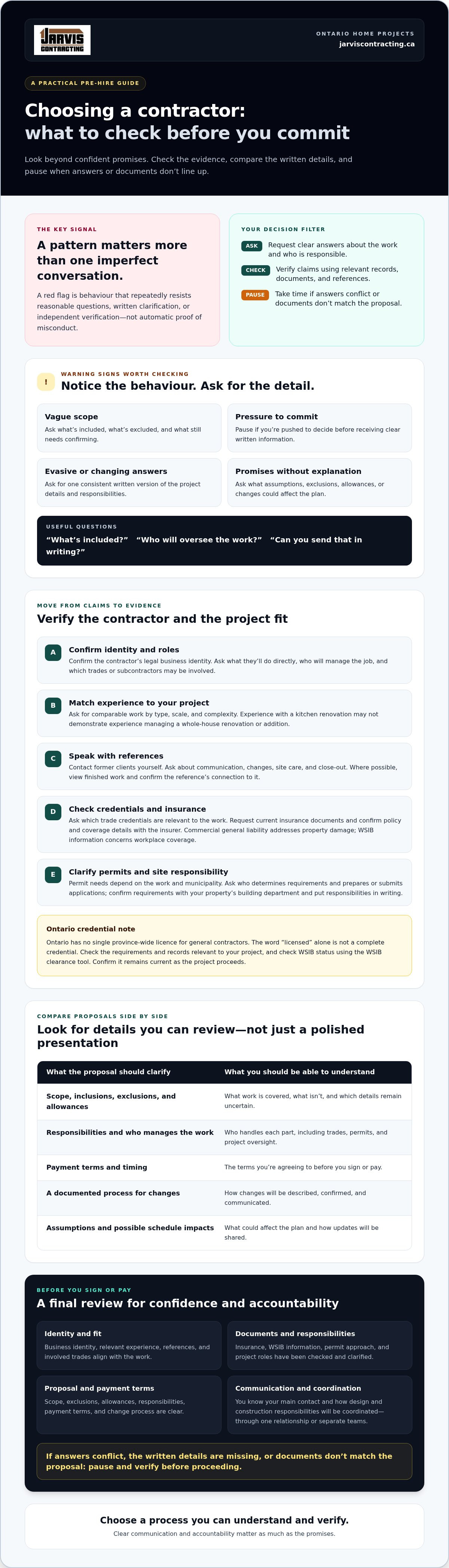
Use this Ontario contractor checklist before you sign or pay
Use this checklist to keep your decision grounded in details you can confirm. For a project in Durham Region or the GTA, direct permit questions to the building department for the municipality where the property is located. Requirements can depend on the work and location, so don’t rely on a general answer when you need project-specific information.
What should your pre-hire checklist include?
Identity: Confirm the business name and the identity of the person preparing your proposal.
Relevant experience: Review examples that match your project’s type and complexity. If you’re assessing a custom-build specialist, read the custom home builders Durham Region guide as part of your research.
References and leadership: Contact former clients and confirm who will lead your project and serve as your main contact.
Documentation: Collect the written proposal, current insurance details, applicable WSIB information, and any relevant trade credentials.
Scope and terms: Check that included work, materials, assumptions, exclusions, payment terms, and change procedures are clear.
Communication: Confirm how you’ll receive updates, who answers questions, and how decisions will be recorded.
Permits: Note what needs confirmation and ask the appropriate local building department about requirements for your property and project.
Keep a separate note of unanswered questions. Resolve them in writing before you sign or pay, and save the responses with the proposal so you can compare them later.
What should you do when a warning sign appears?
Pause and verify. Ask one specific follow-up question, then request the document or clarification that would answer it. If it’s unclear who will lead the project, for example, ask who will manage the work and have that responsibility identified in writing. Compare the response with the proposal, references, and other project information. A clear explanation that resolves a one-time omission is different from an answer that keeps changing or avoids the question.
If details conflict, don’t fill in the gaps yourself. Ask for a corrected proposal or written confirmation, then review the revised information before making a decision. If a material concern remains unresolved, take time to verify it. Urgency is not a substitute for diligence, and you don’t need to sign or pay simply because someone is pressing for an answer.
For a custom home in Durham Region, use the custom home builders Durham Region guide to explore what to consider when assessing a specialist.
Choose a contractor whose process supports your Ontario home project
A sound hiring decision comes from more than a persuasive presentation. Look for consistent answers, clear documents, and communication that makes it evident who is responsible for decisions and follow-through. The signs of a bad contractor before you hire often become clearer when you compare what was discussed with what’s written and see how questions are handled.
How can a coordinated design-build process help?
In a design-build arrangement, design and construction can be coordinated through one project-management relationship. That can make responsibilities and decisions easier to follow, but it doesn’t guarantee lower costs or prevent every problem. Ask who leads communication from early planning through construction, how design decisions affect the project, and who will explain changes. For more context, read about design-build benefits for Ontario homeowners.
Jarvis Contracting offers one local example of this model. The second-generation, family-owned Ontario firm was founded in 2007 and pairs in-house architecture and design with construction management for custom homes, additions, and major renovations. Those details describe its approach, not a reason to assume every design-build firm is the right fit. Evaluate how the proposed team will work with your goals and make responsibilities clear.
What should you clarify in a final contractor conversation?
Before committing, confirm who will be on the project team, who makes or approves key decisions, and how you’ll receive updates. Raise any unresolved questions and request written clarification where the proposal or conversation leaves room for different interpretations. A clear process should help you understand how communication and responsibilities will work, not just what the finished project might look like.
Choose a contractor whose process fits your project and expectations. If you’re considering a custom home, addition, or major renovation, review Jarvis Contracting’s approach and ask how scope, communication, and responsibilities are handled. Use the conversation to assess fit, rather than treating a confident promise as a substitute for clear answers.
Choose your next step with confidence
The signs of a bad contractor before you hire matter most when a contractor’s claims resist reasonable questions or don’t match the written details. Before committing, verify relevant experience and documentation, compare proposals for clear scope and responsibilities, and resolve unanswered questions in writing. A steady process and accountable communication are stronger reasons for confidence than promises alone.
For a custom home, addition, or major renovation, the right fit should make it easier to understand who is guiding the work and how design and construction decisions will be handled. Jarvis Contracting is a family-owned, second-generation Ontario firm founded in 2007, with in-house architecture and design paired with construction management. The firm serves Durham Region, the GTA, and surrounding areas.
Discuss your home project with Jarvis Contracting and ask how the team approaches scope, communication, and responsibilities. Take the time to choose a process that feels clear and considered. With the right questions, you can move forward with greater confidence in the home project ahead.
Frequently Asked Questions
What are the biggest signs of a bad contractor before you hire?
The biggest signs of a bad contractor before you hire are repeated evasiveness, pressure to commit before receiving written details, inconsistent answers, and reluctance to provide documents or references you can verify. A single unclear response may simply need follow-up. Ask specific questions about comparable projects, who will manage the work, what’s included, and how changes are documented. If reasonable questions keep going unanswered, pause and verify the contractor’s claims before signing or paying.
Should I hire a contractor who asks for cash?
A cash payment alone doesn’t prove a contractor is unreliable, but an unexplained cash request is a reason to pause. Ask what the payment covers and make sure the amount, timing, and method match the written agreement. Request an invoice or receipt for every payment, and don’t pay outside the documented terms because of pressure or a promise of a special price. If the contractor resists recording the transaction, consider that a serious accountability concern.
How can I check if a contractor is insured in Ontario?
Ask for a current certificate of Commercial General Liability insurance, then contact the insurer or broker to confirm the policy and coverage details. The research guidance for Ontario homeowners recommends requesting proof of at least C$2 million in liability coverage; confirm what’s appropriate for your project. Also check applicable WSIB information using the WSIB clearance tool. A clearance certificate can be valid for up to 90 days, so verify its status before work and during longer projects.
Can a contractor start renovation work without a permit in Ontario?
Permit requirements depend on the proposed work and municipality, so there isn’t one answer for every renovation. Ask the contractor who will determine what approvals are needed and who will submit any required applications. Confirm project-specific requirements with the building department for the property’s municipality before work begins. This applies whether your home is in Toronto, Whitby, Oshawa, Pickering, Ajax, Port Perry, Uxbridge, Markham, Richmond Hill, Aurora, Vaughan, or King City.
What should be included in a contractor’s written quote?
A useful written quote should describe the work, materials, assumptions, exclusions, allowances, and each party’s responsibilities in clear terms. It should also explain payment timing, how changes are approved and recorded, and how schedule updates will be communicated. Check that the quote reflects what you discussed, and ask about anything unclear before accepting it. Compare proposals for completeness and clarity, not just the total, since different scopes can make headline figures difficult to compare fairly.
Is it a red flag if a contractor asks for full payment upfront?
Yes, a demand for full payment before meaningful work is completed is a reason to pause and ask for a detailed explanation. Payment terms should be written down, explain what each payment covers, and connect to the agreement and documented project progress. There’s no universal payment schedule that suits every project, so review the terms in context. Don’t let pressure to pay outside the agreed terms replace careful review or written clarification.
How many references should I check before hiring a contractor?
There’s no fixed number that applies to every project, but speaking with at least two recent clients can give you more than one perspective. Ask for references whose projects are similar in type or complexity, and confirm their connection to the work. Ask how communication went, how changes were handled, whether the site was cared for, and how the project was closed out. If you can, view completed work as another way to check relevant experience.


Comments