
Home Renovation Payment Schedule: Ontario Guide

Could a payment come due before the work it covers is complete? For Ontario homeowners, that question is central to a fair home renovation payment schedule. A deposit, progress invoice or final balance can be hard to assess if the contract doesn’t explain what work is done, which materials have been supplied, and what each payment covers.
It’s reasonable to want a contractor to have the funds needed to keep a project moving while also expecting invoices to reflect agreed, verifiable progress. A clear schedule makes that connection easier to check. It sets out payment amounts, milestones, how materials are handled and what must be complete before payment is due.
This guide compares milestone-based and calendar-based billing, explains what to clarify in the written contract, and shows you how to review an invoice before approving it. You’ll also find questions to ask about deposits, scope changes and final payment, so you can assess the schedule before work begins and understand how it fits the renovation.
Table of Contents
What Is a Home Renovation Payment Schedule, and What Should It Do?
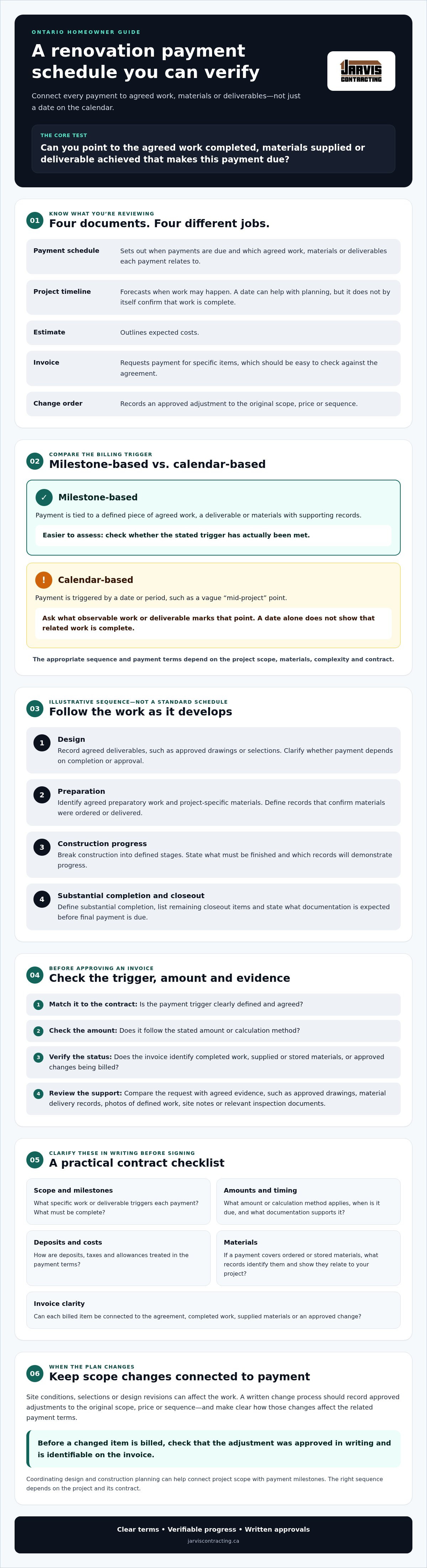
A home renovation payment schedule is a written plan that explains when payments are due and which agreed work, materials or deliverables each payment relates to. It differs from a project timeline, which forecasts when work may happen, and an estimate, which outlines expected costs. An invoice requests payment for specific items. A change order records an approved adjustment to the original scope, price or sequence.
The schedule should help both parties plan. Homeowners can see what must be complete before an invoice is due; contractors can plan for labour, materials and the next stage of work. There’s no single milestone sequence for every project. Scope, materials, complexity and contract structure all affect what’s appropriate. A fair renovation payment schedule is clear, documented and tied to work both parties have agreed on.
Renovations can range from updating one room to changing a home’s layout. For a broad overview of renovation and remodelling, see What Is a Home Renovation. Whatever the project’s scale, the payment terms should explain how its scope translates into payment triggers.
What information belongs in the payment terms?
For each scheduled payment, look for a defined trigger, the amount or calculation method, the due date and the documentation that supports the request. The contract should also clarify how taxes, allowances, deposits and supplied materials are treated. If a payment covers ordered or stored materials, ask what records will identify them and show that they relate to your project.
Invoices should make their connection to the agreement easy to check. They can identify completed work, materials supplied or stored, and any approved changes being billed. If a trigger is described only as “mid-project,” ask what observable work or deliverable marks that point.
Why do major renovations need clearly defined milestones?
A whole-home renovation or addition may move through design, preparation and construction, with trades overlapping as areas become ready for the next stage. Design decisions influence what needs to be ordered. Permits and procurement can affect sequencing, while construction progress depends on work being ready for following stages. A calendar date alone may not show whether the related work is complete.
Written milestones connect those stages to the agreed scope and supporting records. For more context on planning and coordinating a large project, see this major home renovation guide. Coordinating design and construction can also help keep project planning and payment triggers aligned.
How Should Renovation Payments Align With Project Milestones?
A useful payment sequence follows the work as it develops, from design and preparation through construction, substantial completion and closeout. The exact stages, amounts and timing depend on the contract and project. Treat the sequence below as an illustration, not a standard schedule or a schedule offered by any particular contractor.
Design: Record the agreed design deliverables, such as approved drawings or selections. Clarify whether payment is triggered by their completion or approval.
Preparation: Identify agreed preparatory work and project-specific materials. If a payment relates to materials, define what documentation confirms they’ve been ordered or delivered.
Construction progress: Divide the work into defined stages, such as completion of a specified portion of construction. Describe what must be finished and what records will demonstrate progress.
Substantial completion and closeout: State what the contract means by substantial completion, then list any remaining closeout items and the documentation expected before final payment is due.
A milestone payment should match the agreed scope and verifiable project status. Each trigger should be specific enough for both parties to assess whether it has been met. A calendar date can help with planning, but it doesn’t prove that the related work is complete. For guidance on homeowner rights and contract considerations, review the Government of Ontario’s information about a home renovation payment schedule in Ontario.
What can count as a verifiable milestone?
Evidence depends on the trigger and the contract. It might include approved drawings, a material delivery record, photos of defined work, site notes or relevant inspection documents. Agree in advance on what will count. That gives you something concrete to check instead of relying on a date or a general statement that the project is “at the next stage.”
How should invoices and approvals connect?
Compare each invoice description with the matching contract line item and the work completed. If an invoice covers stored materials or an approved change, check that it identifies those items and refers to the supporting record or written approval. Keep questions and responses in writing, and request the agreed supporting documents if a trigger isn’t clear. An unclear invoice doesn’t automatically change the contract terms.
Coordinating design decisions with construction planning can make it easier to define deliverables and sequence work. Learn more about design-build benefits for Ontario homeowners. If you’re considering a major renovation or addition, you can also review how Jarvis Contracting approaches design and construction planning.
Milestone-Based vs. Calendar-Based Billing: Which Schedule Is Easier to Assess?
Milestone-based billing links a payment to defined work or deliverables, as described in the contract. Calendar-based billing makes payment due on a stated date or at regular intervals. Either approach can help organize a home renovation payment schedule, but neither is automatically clear or fair. The contract wording, supporting records and process for handling delays matter most.
What are the trade-offs of each billing approach?
Milestones can make it easier to compare an invoice with completed work, but only if each trigger is specific and verifiable. Calendar billing can make cash-flow planning more predictable, but a date alone doesn’t confirm that a particular stage is complete. Weather, approvals, supply delays or trade sequencing can shift planned work. The written agreement should explain whether a delay changes a payment date, trigger or obligation, so neither party has to guess.
For a renovation in Ontario, review the contract terms alongside the Government of Ontario’s guidance on Ontario's Consumer Protection Act. The right billing model depends on the project and written terms, not simply on its label.
What warning signs should homeowners question?
Ask for clarification if a trigger says “as work progresses” but the contract doesn’t define what progress means. Get written details about extras, responsibility for materials and records supporting an advance payment. If an invoice requests payment for incomplete work, compare it with the agreed trigger and ask for an explanation before approving it. Unclear or disputed terms, particularly those with significant consequences, are a good reason to seek independent legal advice.
How to Review a Home Renovation Payment Schedule in Ontario
Before signing, read the payment terms alongside the scope, drawings, estimate and any other documents that form the agreement. A home renovation payment schedule is useful only if its triggers match the work described elsewhere and everyone understands how invoices and changes will be handled.
Which contract details should homeowners confirm before signing?
Use this checklist to spot gaps and ask for clear wording:
Scope and exclusions: Confirm that the documents agree on what work is included, what is excluded and how allowances are treated.
Payment triggers: Check that each trigger describes a defined task, deliverable or other agreed condition, rather than a vague project stage.
Invoices and records: Ask who reviews invoices and what records must support each request, such as descriptions of completed work or materials.
Timing and delays: Clarify when payment is due and how incomplete, disputed or delayed work affects the schedule.
Changes and approvals: Confirm that changes to scope, price or sequencing require written approval, and that the documents explain how they affect payment triggers.
For an addition, design choices, existing conditions and construction sequencing can all shape the scope. The home addition contractors in Ontario guide offers planning context to consider alongside the payment terms.
What Ontario rules should be checked with a qualified professional?
Ontario construction requirements can depend on the project, the parties and the contract. Treat the Construction Act as a topic for current, project-specific legal review, not as a one-size-fits-all rule. Ask an Ontario construction lawyer whether statutory holdback or prompt-payment provisions apply to your arrangement and what the contract should say about them.
Practical contract review helps you identify unclear terms; it isn’t legal advice about your rights or obligations. If a payment clause is disputed or could have significant consequences, get advice from a qualified legal professional before relying on your own interpretation.
For a major renovation or addition, coordinated design and construction planning can help keep scope documents and payment milestones aligned. Explore Jarvis Contracting’s design-build services as you consider the right project approach.
Managing Renovation Payments When Scope or Site Conditions Change
Renovation plans can shift after work begins. Opening a wall may reveal concealed conditions that weren’t visible during planning. A homeowner may choose a different finish, or a design revision may change the work sequence. Each change can affect scope, timing and payment milestones, so document it in the project records rather than leaving it to be sorted out through a later invoice.
How should a change order affect the payment schedule?
Before additional or revised work proceeds, document the proposed change and its effect on the agreement. A written change order should describe:
The added, removed or revised work, including relevant materials or selections.
How the change affects the schedule or existing milestones.
The price basis and any related payment timing.
Who must approve the change and how that approval is recorded.
Whether it creates a separate payment trigger or revises an existing one.
Keep the approved change order with the updated schedule and any related invoice. This gives everyone a shared record of what was authorized and helps you check that a later payment request matches the revised scope. Don’t treat an undocumented extra as automatically approved. If an unexpected condition raises an immediate safety concern, seek appropriate professional direction and record the issue and actions taken. That doesn’t remove the need to clarify contractual changes.
A well-managed home renovation payment schedule should reflect approved changes, not just the original plan. Clear records are especially useful on major renovations and additions, where a design revision or concealed condition may affect several stages of work.
What are sensible next steps before choosing a contractor?
Compare proposed schedules as carefully as estimates and project timelines. Ask how clearly each one defines payment triggers, what records support invoices and how changes are approved. Confirm who will coordinate design decisions, construction communication and payment documentation, and how scope updates will be shared. The goal is a process you can understand before work starts, not simply a set of dates on a page.
Jarvis Contracting integrates in-house architecture and design with construction for Ontario residential projects. If you’re considering a major renovation or addition in Toronto, Whitby, Oshawa, Pickering, Ajax, Port Perry, Uxbridge, Markham, Richmond Hill, Aurora, Vaughan or King City, contact Jarvis Contracting to discuss project planning and how scope, sequencing and payment records can be considered together.
Set Your Renovation Up for a Clearer Start
A clear home renovation payment schedule connects each payment to defined work, deliverables or agreed timing, with supporting records that make invoices easier to review. Before signing, compare the schedule with the project scope and confirm how delays, approved changes and disputed work affect payment terms. If site conditions or design choices shift the plan, document the change and update the relevant milestones before treating new work as approved.
Good planning brings these details together. Jarvis Contracting is a second-generation, family-owned and operated Ontario firm founded in 2007, with in-house architecture and design integrated with residential construction. The firm serves Durham Region, the Greater Toronto Area and surrounding regions, including Toronto, Whitby, Oshawa, Pickering, Ajax, Port Perry, Uxbridge, Markham, Richmond Hill, Aurora, Vaughan and King City. Its coordinated approach helps homeowners consider project scope and construction planning together, while the contract sets out the specific payment terms.
Have a major renovation, addition or other residential project in mind? Discuss your renovation plans with Jarvis Contracting and take the next step with a clearer understanding of what to ask and review.
Frequently Asked Questions
What is a typical home renovation payment schedule?
There’s no universal home renovation payment schedule. A written agreement may link payments to defined stages, documented work or agreed dates. The right structure depends on the project’s scope, duration, materials and contract terms. For projects in Toronto, Whitby, Oshawa, Pickering, Ajax, Port Perry, Uxbridge, Markham, Richmond Hill, Aurora, Vaughan or King City, review each trigger, amount or calculation method, invoice requirement and change process rather than relying on a generic online percentage.
Is it normal for a contractor to ask for a deposit?
A deposit may be included in a renovation agreement, but its amount and terms vary by project and contract. Before paying, ask what it covers and how the payment will be recorded. Check what the agreement says about materials, cancellation and refunds, including any custom-ordered items. If the requested deposit or refund terms are unclear or significant, consider having an Ontario legal professional review the agreement before you sign.
How much should I pay a contractor before work starts?
There isn’t one amount that suits every renovation, so avoid relying on a standard figure or percentage. The contract should explain the basis for any payment due before work starts and connect it to clear terms, such as agreed preparation or procurement. Check how the funds and any materials are treated, along with cancellation terms. Compare the request with the full scope and payment schedule before signing.
Should renovation payments be based on milestones or dates?
Either approach can work if the contract explains it precisely. Milestone payments should refer to verifiable work or deliverables, such as completion of a defined stage. Date-based payments should state the relevant date or billing period and explain how delays affect payment. Compare the project’s complexity, documentation needs and work sequence, then choose terms both parties can understand and administer. The label alone doesn’t make a schedule clear.
Can I withhold payment if renovation work is incomplete?
Whether you can withhold payment depends on the contract, the incomplete work and the law that applies to the project. Document the issue, compare it with the agreed payment trigger and raise your concern promptly in writing. Ask for clarification and keep relevant records. Don’t decide to withhold payment without legal advice, since a payment dispute may have contractual or statutory consequences. An Ontario lawyer can advise on your specific situation.
What happens if renovation work changes after the contract is signed?
A change should be described and approved in writing before additional or revised work proceeds, where practical. The record should set out the changed scope, price basis, timing and effect on payment triggers. Concealed conditions or urgent circumstances may need special handling, so check the contract and seek appropriate professional guidance rather than assuming the original schedule still applies. Keep the approval with the updated schedule and any related invoice for a clear project record.
Do Ontario renovation contracts require a holdback?
Ontario’s Construction Act contains holdback provisions, but whether and how they apply depends on the project, contract and current law. Don’t assume a particular percentage, deadline or outcome applies to every homeowner. Ask an Ontario construction lawyer to review your specific arrangement, confirm any obligations and check that the contract language reflects current requirements. This is especially useful if the agreement’s holdback terms are unclear or differ from what you expected.


Comments