
Switching from a Bad Contractor Mid-Project: An Ontario Homeowner’s Guide

Updated: 3 days ago
Imagine standing in your kitchen, surrounded by exposed studs and half-laid tile, while your contractor’s phone goes straight to voicemail for the third day in a row. It’s a heavy, sinking feeling to realize the person you trusted with your home and your investment isn't going to finish the job. You aren't alone in this frustration. Recent data shows that Ontario homeowners generate 59 percent of all construction-related inquiries in Canada, often seeking a way out of a failing agreement. While the stress of a stalled renovation is overwhelming, switching from a bad contractor mid-project is a manageable recovery mission when you have the right roadmap.
We understand that you’re likely worried about losing your hard-earned money or facing legal liens on your property. This guide provides the exact steps you need to safely terminate a failing contract under Ontario’s latest 2026 regulations and transition to a reliable design-build firm. We’ll walk you through the legal requirements for notice of termination, how to document existing deficiencies, and the process of finding a partner who values craftsmanship as much as you do. You deserve a home that reflects your vision, and more importantly, the peace of mind that comes with a project done right.
Table of Contents
Recognizing the Red Flags: When Is It Time to Switch?
A home renovation is a significant investment of both capital and emotion. It’s an act of trust that your contractor will treat your property with the same respect they would their own. When that trust begins to erode, it’s rarely because of a single isolated incident. Instead, it’s a slow accumulation of missed deadlines, silent phones, and work that simply doesn't look right. Recognizing these patterns early is the first step toward switching from a bad contractor mid-project before the damage becomes irreversible.
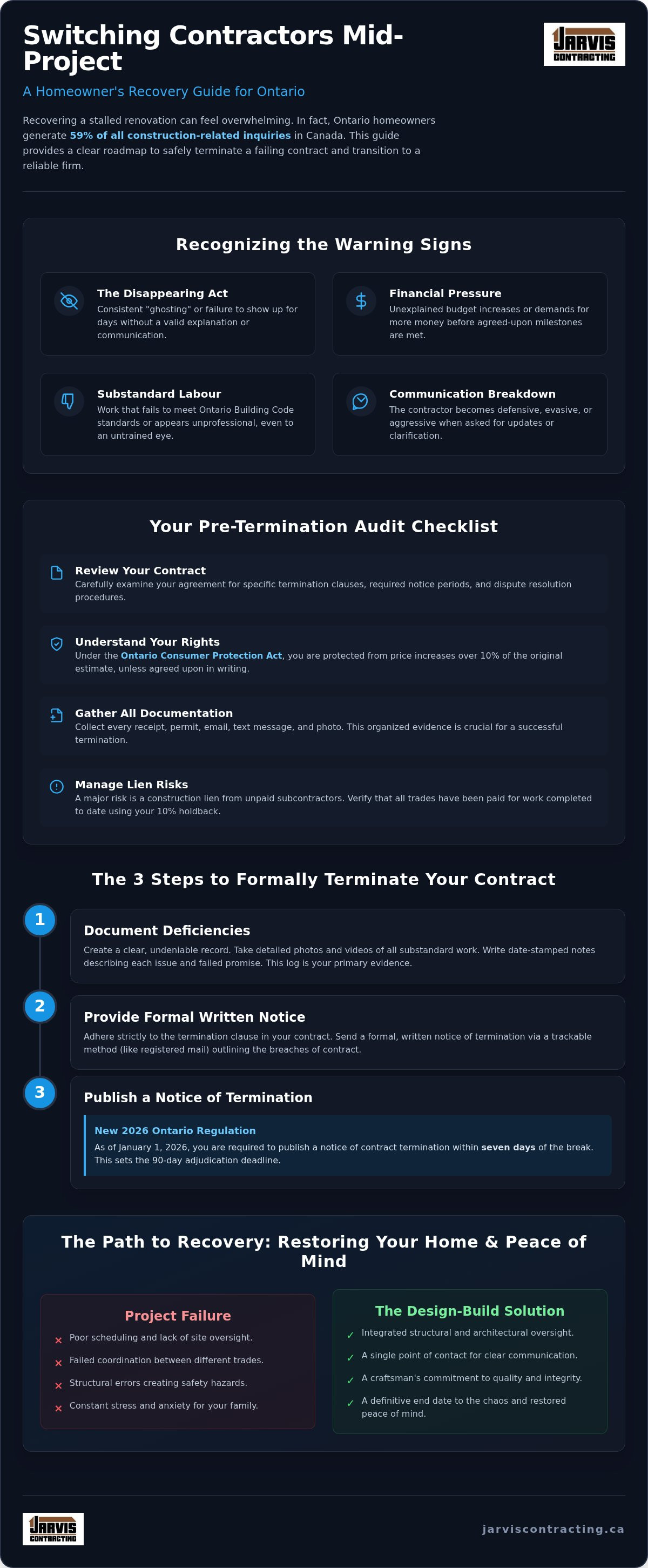
The most common warning signs include:
The Disappearing Act: Consistent failure to show up or "ghosting" for days without a valid explanation.
Financial Pressure: Unexplained budget increases or requests for more money before agreed-upon milestones are met.
Substandard Labour: Work that clearly fails to meet Ontario Building Code standards or looks unprofessional even to an untrained eye.
Communication Breakdown: A contractor who becomes defensive, evasive, or aggressive when you ask for updates or clarification.
Every project is governed by its construction contract, which should outline expectations for performance. If the person you hired is consistently operating outside those bounds, the project's integrity is at risk.
The Difference Between Normal Delays and Project Failure
It’s vital to distinguish between external challenges and internal mismanagement. Supply chain issues or extreme weather are often outside a contractor's control. However, poor scheduling, a lack of site oversight, and failing to coordinate trades are symptoms of project failure. You can forgive a delayed shipment of custom tile; you cannot forgive structural errors that create safety hazards. Documenting these failures with photos and date-stamped notes is essential. This log creates a clear trail of evidence that justifies a transition to a more reliable firm.
Assessing the Emotional Toll on Your Family
Living in a perpetual construction zone in the GTA takes a heavy toll on your mental well-being. Your home should be a sanctuary, not a source of constant anxiety. When the stress of managing your contractor outweighs the hope of them actually "fixing it," you've reached a tipping point. Many homeowners hesitate because they fear the cost of starting over. In reality, switching from a bad contractor mid-project is often the most cost-effective path. A fresh start with an integrated design-build team stops the financial bleed and puts a definitive end date on the chaos, finally restoring the peace of mind your family deserves.
The Ontario Homeowner’s Audit: Financial and Legal Protection
Before you finalize the separation, you must conduct a thorough financial and legal audit. This process moves the project from a state of emotional distress to one of objective fact. Start by reviewing your existing agreement for specific termination clauses and notice periods. Under the Ontario Consumer Protection Act, homeowners are protected from price increases exceeding 10 percent of the original estimate unless new work is agreed upon in writing. It’s vital to understand your rights when signing or cancelling a contract before you take the next step.
Gather every receipt, permit document, and email thread. As of January 1, 2026, Ontario regulations require a notice of contract termination to be published within seven days of the break. This date is the official benchmark for the 90-day adjudication deadline. Having your records organized ensures you meet these strict timelines without losing your investment. Successful switching from a bad contractor mid-project depends on this foundation of documented evidence.
Managing Liens and Subcontractor Payments
One of the greatest risks when switching from a bad contractor mid-project is the construction lien. In Ontario, the law mandates a 10 percent holdback on all payments to ensure trades are paid. If your main contractor has been pocketing these funds instead of paying their crew, the subcontractors may look to your property title for compensation. Verify that all trades have been paid for work completed to date. If the financial trail is murky, a firm specializing in major renovations can often help you assess the value of work on-site versus what has been billed.
Building Permit and Inspection Status
Your next stop is the local building department in Whitby, Markham, or Toronto. You must verify the status of your permits. A failing project often hides unpermitted work or missed inspections, which can lead to safety hazards or forced demolition later. Ensure all completed work has passed the necessary municipal checks. Entering a new partnership with a clear permit history is the only way to protect your home’s long-term value and your family's safety.
How to Properly Terminate Your Current Construction Contract
The process of switching from a bad contractor mid-project requires a surgical approach to communication. You must move from casual conversations to formal, legal declarations. Before you send a final termination notice, it’s often necessary to issue a "Notice to Cure." This document serves as a final warning, giving the contractor a specific window, usually three to seven days, to rectify the breaches you’ve identified. It demonstrates that you’ve acted in good faith and provided every reasonable opportunity for the project to succeed.
If the deadline passes without significant improvement, you must move to official termination. This isn't a text message or a phone call. It’s a formal letter sent via registered mail or delivered through legal counsel. Documentation is your strongest shield during this transition. Before the contractor leaves the property for the last time, take high-resolution photos and videos of every corner of the site. This visual record captures the exact state of the work, which is vital if you later need to prove deficiencies or defend against a lien.
The Paper Trail: Writing the Termination Letter
Your termination letter should be a calm, factual account of why the relationship is ending. List the specific clauses in the agreement that were violated, such as missed milestones or safety failures. Referencing Your rights under the Consumer Protection Act can reinforce your position. Clearly state the effective date of termination and set a firm deadline for the removal of their equipment. Demand the immediate return of all keys, fobs, and digital access codes. Keeping the tone professional rather than emotional prevents the contractor from claiming they were treated unfairly.
Securing the Construction Site
Once the notice is delivered, your priority shifts to protecting your property. Change the locks. Update your security codes. You must prevent the unauthorized removal of materials you’ve already paid for, such as uninstalled cabinetry or fixtures. It’s also a good time to call your insurance provider. Many policies have specific requirements for properties under construction, and a change in contractor can affect your coverage. Ensure the site is safe and weatherproofed for the interim period. A clean, secure site makes it much easier for a new team to step in and begin the recovery process without dealing with avoidable damage or theft.
Remember that as of January 1, 2026, Ontario law requires you to publish a notice of termination within seven days of the official break. This is a critical step in switching from a bad contractor mid-project as it sets the legal clock for holdback releases and potential adjudications. Following these procedures exactly protects your home and your financial future.
Finding a professional willing to step into a half-finished construction site is notoriously difficult. Most general contractors hesitate because they inherit the legal and structural liabilities of the person who came before them. When you are switching from a bad contractor mid-project, you aren't just looking for a builder; you’re looking for a partner who can untangle a web of errors. This is where the design-build model becomes your greatest asset. It provides the diagnostic tools necessary to identify hidden flaws before they are buried behind new drywall.
In a traditional construction model, the architect and the builder often operate in silos. If a wall is crooked or a plumbing stack is misplaced, the "blame game" begins. The builder blames the drawings while the architect blames the execution. An integrated design-build firm eliminates this friction. By housing in-house architecture and design alongside construction management, there is a single point of accountability. This unity is the only way to ensure that the vision for your home is restored without further communication gaps or finger-pointing.
The Diagnostic Phase: Auditing the Previous Work
Professional firms like Jarvis Contracting don't just pick up a hammer and start working on a rescue site. We begin with a comprehensive audit of the existing work. This phase involves evaluating the integrity of the framing, electrical, and plumbing to ensure everything meets the Ontario Building Code. In many cases, it is also necessary to bring in specialized trades, such as I R. Wilson Roofing, to assess and repair the building's exterior envelope. We then create a "Correction and Completion" plan. This roadmap prioritizes safety and structural stability before moving on to the aesthetic finishes you originally envisioned. It’s about building a foundation of trust and technical accuracy before the first new nail is driven.
It’s important to be realistic about the financial side of a recovery mission. Fixing someone else’s mistakes often carries an initial premium because it involves "undoing" before "doing." However, long-term project management actually saves money. By preventing further errors and ensuring every trade is coordinated, a design-build firm stops the cycle of wasted materials and repeated labour. When switching from a bad contractor mid-project, the value lies in the certainty of the outcome. You are investing in a firm that treats your home as a reflection of their own heritage and standards. If you are ready to move from chaos to a clear path forward, contact our team to discuss your project recovery.
The Jarvis Recovery Process: Restoring Your Home and Peace of Mind
At Jarvis Contracting, we recognize that your home is more than just a job site; it's the foundation of your family's daily life. When you're in the position of switching from a bad contractor mid-project, the emotional weight is often as heavy as the financial burden. You aren't simply looking for someone to finish the framing or install the cabinetry. You're looking for a partner who can restore the trust that was broken. As a second-generation, family-owned firm founded in 2007, we take that responsibility personally. Our work is a reflection of our family name, and we bring a legacy-builder's perspective to every recovery mission we undertake.
Our process is designed to replace uncertainty with a methodical, reassuring rhythm. We don't rush into the finishing stages. Instead, we slow down to ensure the foundation of the project is sound. This commitment to quality craftsmanship means we honour the potential of your home by doing things right the first time. We believe that clear communication is the only way to build a successful partnership, especially when you've been left in the dark by a previous builder. From the first meeting to the final walkthrough, you'll always know exactly where your project stands.
From Chaos to Coordination: Our Integrated Approach
The design-build model is the most effective antidote to the stress of switching from a bad contractor mid-project. Instead of you acting as the middleman between a designer and various trades, we provide a single point of contact. This integrated approach streamlines the transition. Our in-house architecture and design team works in tandem with our construction managers to diagnose structural "messes" and create a cohesive path forward. We handle the complexities of municipal bureaucracy for you, managing permits and inspections across Toronto, the Durham Region, and Muskoka. By replacing a disjointed group of trades with one expert team, we eliminate the communication gaps that lead to errors.
Taking the First Step Toward Completion
Realizing your original dream for your home is still possible. It starts with a professional assessment of your project's current viability. We look past the current chaos to see the finished home you were promised. During our initial consultation, we'll discuss how to align your vision with a realistic timeline and a professional standard of excellence. You don't have to live in a construction zone forever. When you're ready to move forward with a team that values integrity and precision, Contact Jarvis Contracting for a project recovery consultation.
Reclaiming Your Home’s Future and Peace of Mind
Realizing your renovation has gone off course is a heavy burden, but it doesn't have to be the end of your dream. By identifying red flags early and following the proper legal channels under Ontario’s latest regulations, you can protect your investment. The transition to a professional partner is about more than just finishing a floor plan; it’s about restoring the sanctuary of your home. Switching from a bad contractor mid-project is a strategic move that requires precision and a deep commitment to quality.
As a second-generation, family-owned firm serving the GTA and Durham Region since 2007, Jarvis Contracting understands the stakes. Our integrated approach combines in-house architectural design and construction management to eliminate the communication gaps that cause projects to fail. You deserve a home that reflects your vision and a building process that respects your environment. If you're ready to move past the chaos and toward a beautifully completed space, book a project recovery consultation with Jarvis Contracting today. Let’s finish what was started with the integrity and craftsmanship your home deserves.
Frequently Asked Questions
Can I fire my contractor if there is no written contract?
Yes, you can terminate the relationship even without a formal document, as verbal agreements are considered binding under Ontario law. However, proving the terms of your agreement is much more difficult without a written record. You must compile all texts, emails, and bank records to establish the scope of work and payment history. We recommend consulting a legal professional to ensure you don't inadvertently breach your verbal obligations during the separation process.
Will a new contractor charge more to take over an unfinished project?
Most reputable builders in the GTA charge a premium to take over an existing site because they inherit the liability of the previous contractor's work. They must often "undo" substandard work before they can move forward safely. While the initial cost may seem higher, switching from a bad contractor mid-project to a professional firm prevents expensive future repairs and ensures the project finally meets the Ontario Building Code.
How do I know if my contractor has abandoned the job legally?
Legal abandonment is typically established when a contractor ceases work for a specific period, often 14 to 30 days, without a valid reason or communication. In Ontario, the Construction Act defines project abandonment based on the last day work was performed or materials were supplied. Document every day the site is empty with photos. This evidence is crucial if you need to prove the contract was frustrated by their lack of performance.
What should I do if a subcontractor puts a lien on my house?
If a subcontractor files a lien against your property in Durham Region or Toronto, you should immediately contact a construction lawyer. This often happens because the main contractor failed to pay their trades despite receiving your payments. You may be required to pay the 10 percent mandatory holdback into a court fund to vacate the lien from your title. This ensures the trades are protected while you resolve the dispute with your original contractor.
Is it possible to recover money paid for work that was never finished?
You can pursue the recovery of funds through the Ontario court system, though the success depends on the quality of your documentation. If the amount is under $35,000, you can use Small Claims Court to seek a resolution. For larger sums, you'll need to file a claim in the Superior Court of Justice. Having a detailed audit of "work completed versus money paid" is the only way to prove you're owed a refund.
Does a new contractor need to pull new building permits in Ontario?
A new builder doesn't usually need to pull entirely new permits, but they must update the existing ones with your local municipality, such as Whitby, Markham, or Oshawa. The building department requires the new contractor’s information and insurance details to be on file before inspections can continue. This transfer ensures that the new firm is legally responsible for the work moving forward and that all subsequent inspections are properly recorded.
How can I check if a contractor is properly insured in the GTA?
You should always request a current Certificate of Insurance and a WSIB clearance certificate from any contractor operating in the GTA. Don't just take their word for it; call the insurance provider directly to confirm the policy is active and covers residential construction. A professional firm will have no issue providing these documents, as they are foundational to a legitimate business and protect you from liability for on-site injuries or property damage.
What is the benefit of a design-build firm for a project rescue?
The primary benefit of a design-build firm is the integration of architectural design and construction management under one roof. When switching from a bad contractor mid-project, you need a team that can diagnose structural errors and redesign failing elements without the "blame game" common between separate architects and builders. This single point of contact provides a clear, methodical path to completion while ensuring every detail meets high craftsmanship standards.


Comments