
How to Choose a Design-Build Contractor in Ontario: The Homeowner’s Checklist (2026)

Most homeowners believe that hiring an architect and a builder separately is the safest way to control costs; however, in the complex Ontario construction landscape of 2026, this fragmented approach often leads to the very "budget creep" they hope to avoid. When you are planning a legacy project like a custom home in the GTA or a unique property across Southern Ontario, the traditional method frequently results in a design that looks beautiful on paper but proves impossible to build within your financial reality. Learning how to choose a design build contractor is the most critical step in ensuring your vision remains grounded in practical, high-quality execution from the very first sketch.
It is natural to feel protective of your investment, especially when navigating the stress of local permits and the confusion of coordinating separate professionals. You deserve a process defined by sincerity and a single point of accountability. This guide provides a checklist to help you vet firms, ensuring they possess the in-house design expertise and craftsmanship required to deliver your project on time. We will explore how to identify true integration and secure the budget certainty necessary to build a bespoke home that reflects your family's unique lifestyle.
Table of Contents
Defining the Design-Build Partnership for Your Home
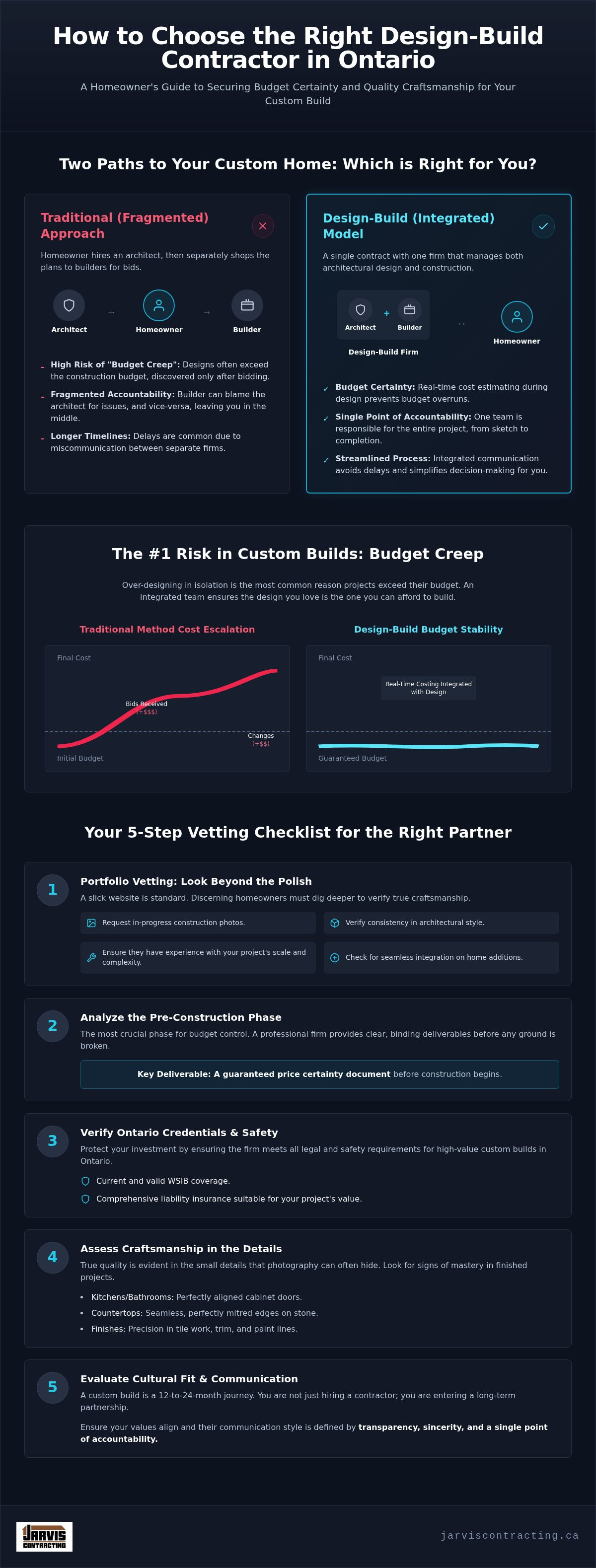
Most homeowners begin their journey with a dream and a preliminary sketch. In the traditional "design-bid-build" model, you hire an architect to draw that dream, then shop those drawings around to different builders to see who can execute the work for the lowest price. This often leads to frustration when the bids come in significantly higher than the original budget. The design-build model fundamentally changes this dynamic by bringing the designer and the builder under one roof from the very first day of the project.
For busy professionals in the GTA or families planning a legacy retreat in Muskoka, this integration offers a significant emotional relief. It removes the burden of project management from your shoulders and places it on a single, unified team. However, this approach requires a mindset shift. You aren't just purchasing a service; you're entering a partnership based on transparency and shared goals. Understanding this collaborative spirit is the first lesson in learning how to choose a design build contractor who aligns with your long-term vision.
The Single Contract Advantage
When you sign a single contract, you establish a clear and unbreakable line of responsibility. In traditional construction setups, if a window leaks or a structural beam is misaligned, the builder might blame the plans while the architect blames the execution. You are often left in the middle, paying for the time spent on the dispute. With design-build, the team is responsible for both the drawing and the result. This unified approach protects your project timeline because technical decisions happen in real-time, avoiding weeks of back-and-forth emails between separate firms. A design-build contract is a unified accountability framework that ensures the person who designed the home is also the one responsible for its structural integrity and final delivery.
Budget and Design Integration
Over-designing is perhaps the most common reason custom projects fail to break ground in Ontario. A designer working in isolation might specify a complex roofline or a custom stone facade that looks stunning on paper but adds C$100,000 to the construction cost without warning. In an integrated firm, the builder provides real-time estimating during every phase of the architectural process. They can tell the designer immediately if a specific material choice will push the project over the agreed-upon limit. This synergy is one of the primary benefits of design build construction. It ensures that the home you fall in love with during the conceptual phase is actually the home you can afford to build. When you are researching how to choose a design build contractor, ask how their internal communication prevents these budget surprises before they happen.
Portfolio Vetting: Evaluating Craftsmanship and Range
A polished online gallery is the standard for any reputable firm; however, discerning homeowners must look beyond the staged lighting and high-end furniture. Professional photography can mask structural shortcuts or poor material choices that only become apparent over time. When you are determining how to choose a design build contractor, request to see in-progress construction photos. These unpolished shots reveal the "bones" of a project, showing you the cleanliness of the site, the precision of the framing, and the quality of the insulation and waterproofing before the drywall hides them.
Consistency in architectural style is another vital indicator. A firm that excels at sleek, Muskoka modern farmhouses may not be the right fit for a traditional Victorian restoration in Toronto. You want to see projects that match the scale and complexity of your own vision. Building a custom 5,000-square-foot estate requires a different level of logistical management than a single-room renovation. Reviewing a builder's range ensures they have mastered the specific structural challenges your home will present.
Assessing Material Quality and Finishes
Look for signs of high-end craftsmanship in the smallest details. In kitchens and bathrooms, check for perfectly aligned cabinet doors and seamless mitred edges on stone countertops. In home additions, the new structure should feel like a natural extension of the original building, not an awkward attachment. We believe functional beauty is the primary goal. Every bespoke element should serve a purpose while standing as a testament to the builder's skill. You can see these standards in action by reviewing our recent project gallery.
Experience with Local Architectural Styles
Ontario’s geography demands specialized knowledge. Vetting a builder’s ability to work within GTA heritage districts requires understanding strict municipal bylaws and preservation standards. Similarly, Muskoka builds must account for rugged terrain, rocky shorelines, and extreme seasonal shifts. Choosing among the top design build firms GTA residents trust means finding a team that understands these local nuances. When considering how to choose a design build contractor, prioritize those who have successfully navigated the specific environmental and legal landscape of your region.
Analyzing the Pre-Construction and Budgeting Phase
Breaking ground is the exciting part, but the success of your custom home or major renovation is actually determined months earlier. The pre-construction phase is the most critical part of your vetting checklist because it sets the financial and structural boundaries for the entire project. A professional design-build firm should never rush this stage. Instead, they should provide a comprehensive feasibility study that examines local Ontario zoning bylaws, soil conditions, and the structural integrity of existing foundations before a single hammer is swung.
When you are evaluating how to choose a design build contractor, look for a firm that treats pre-construction as a rigorous, standalone service. This phase should result in a clear roadmap that includes a detailed scope of work and a fixed-price agreement. If a contractor offers a "ballpark" figure over the phone without a site visit or a deep dive into your requirements, they are likely low-balling the estimate to win the contract. This practice leads to high-stress "change orders" later that can derail your budget and damage the trust between you and your builder.
The Estimating Process
Transparent pricing is the foundation of a trust-based partnership. A professional firm uses realistic "allowances" for your finishes, such as flooring, cabinetry, and fixtures, based on the quality level you discussed during the design phase. If these allowances are set too low just to make the initial quote look attractive, you will end up paying the difference out of pocket later. A detailed estimate should include specific trade quotes, not just round numbers. This level of precision shows that the builder has actually consulted with their electricians, plumbers, and carpenters to verify the current market costs for your specific project.
Project Management and Scheduling
Modern construction requires modern communication. Ask potential firms about the project management software they use to track daily progress and manage timelines. You should have a clear understanding of the communication frequency; whether it is a weekly site meeting or a digital dashboard update, you deserve to know exactly where your project stands. This structured approach is a key differentiator when comparing a design build vs general contractor. During a whole-home remodel, the "unforeseen" is almost inevitable, especially in older Ontario residences. A seasoned team will have a clear, documented process for handling these discoveries without halting progress or causing unnecessary financial strain. Understanding these internal systems is vital as you learn how to choose a design build contractor who can navigate complexity with steady, professional confidence.
Ontario Credentials: The Legal and Safety Checklist
Building a custom home or a major addition in Ontario involves a complex web of legal obligations that many homeowners overlook until a problem arises. When researching how to choose a design build contractor, your first step should be verifying Workplace Safety and Insurance Board (WSIB) coverage. This protects you from being held liable if a worker is injured on your property. Beyond safety, a firm must carry comprehensive liability insurance specifically tailored for high-value residential builds. This coverage ensures that your investment is protected against accidental damage during the construction process.
For those planning a new build, registration with the Tarion Warranty Corporation is a legal requirement in Ontario. Tarion provides a multi-year warranty on your new home, covering everything from minor defects to major structural issues. A reputable firm will be transparent about their registration status and their history of claims. In regions like Durham and the GTA, building departments are rigorous. A family-owned firm often carries a higher level of accountability in these local permit offices; when a business is built on a multi-generational legacy, their reputation with local inspectors is a point of personal pride.
Licensing and Professional Memberships
Professional credentials serve as a benchmark for quality and ethics. You should always verify that a firm holds a valid municipal business licence for your specific region, whether it is Toronto, Whitby, or Muskoka. Memberships in industry organizations like BILD (Building Industry and Land Development Association) or the Renomark program indicate a commitment to a higher code of conduct. These credentials are non-negotiable for complex projects like second-storey additions, where structural integrity and adherence to the Ontario Building Code are paramount for your family's safety.
Permit Management
Navigating the bureaucracy of a Committee of Adjustment or a local conservation authority can be overwhelming for most homeowners. A truly integrated firm takes full ownership of this process, acting as your advocate before municipal boards. They understand the nuances of the Ontario Building Code and how to secure approvals for modern farmhouse designs or traditional additions. The design-build firm is responsible for securing all necessary structural and plumbing permits. If you want to ensure your project meets every legal standard from the start, you can contact our team to discuss your project requirements.
Assessing Cultural Fit and Communication Style
Selecting a design-build firm is a commitment that usually spans 12 to 24 months. You aren't just selecting a service provider; you're inviting a team into your life to shape your most personal environment. When learning how to choose a design build contractor, the technical skills are essential, but the cultural fit determines the quality of your daily experience. Pay attention to the "vibe" during your first consultation. Is the contractor listening more than they are talking? Are they providing honest, perhaps even difficult, feedback about your ideas? Transparency in these early moments is a reliable indicator of how they will handle challenges six months into construction.
Interpreting this initial interaction is vital. You want to ask specific questions to gauge their honesty, such as "Can you tell me about a time a project went over budget and how you handled it?" A firm that admits to past challenges and explains their solution is far more trustworthy than one that claims every project is perfect. This honesty is the foundation of a partnership that survives the inevitable stresses of a major renovation or custom build.
The Personal Touch in Construction
A bespoke project requires a team that is personally invested in the outcome. Since our founding in 2007, Jarvis Contracting has operated as a second-generation, family-owned business. This heritage shapes every interaction we have with our clients. We view each project as a reflection of our family's reputation, which fosters a level of sincerity and quiet confidence that larger corporate firms often lack. When you evaluate a firm, look at their response time during the initial inquiry phase. A team that values your time before a contract is signed is far more likely to maintain that respect when the project is in full swing.
Final Checklist: The Decision Framework
Every homeowner needs a framework to move from research to a final decision. While budget is always a factor, the lowest bid is rarely the best value if it lacks the integration and accountability we have discussed. Trusting your gut is often the final step in learning how to choose a design build contractor. If a firm's portfolio is excellent and their credentials are solid, but the communication feels forced, the project will likely be stressful. Prioritize these must-have qualities:
Proven experience with projects of a similar scale and architectural complexity.
Total transparency regarding allowances and trade quotes.
A clear, documented process for project management and weekly communication.
A sense of shared values and a protective attitude toward your home environment.
Your home is a legacy in the making. If you are ready to partner with a team that values craftsmanship as much as you do, we invite you to book a consultation with Jarvis Contracting to discuss your vision today.
Building Your Legacy with Confidence
Selecting the right team for your custom home is a decision that shapes your family's environment for decades. By focusing on unified accountability and a rigorous pre-construction phase, you protect your vision from the fragmented communication and hidden costs that often plague traditional builds. Learning how to choose a design build contractor is ultimately about finding a partner who balances elite technical expertise with a protective, personal commitment to your project's success.
Since 2007, Jarvis Contracting has operated as a family-owned firm specializing in bespoke custom builds across the Durham Region and the GTA. We integrate architectural design and construction management under one roof to ensure every detail reflects your lifestyle and our high standard of craftsmanship. If you're ready to move from initial concepts to a masterfully executed home, we're here to guide you through every step of the process. Start your design-build journey with Jarvis Contracting today and experience the peace of mind that comes from a truly integrated partnership. We look forward to helping you realize a home that stands as a lasting testament to your family's values.
Frequently Asked Questions
How is a design-build contractor different from a general contractor?
A design-build firm provides a single point of accountability for both the architectural design and the physical construction. While a general contractor typically executes plans provided by an external architect, the design-build model integrates these phases under one contract. This unity eliminates the common friction between design and execution. It ensures that the person building your home fully understands the technical nuances of the original drawings, reducing the risk of costly errors on-site.
Is design-build more expensive than hiring an architect and builder separately?
The design-build model is often more cost-effective because it prevents "over-designing" a home beyond your financial reality. In traditional models, you might pay for architectural plans that prove too expensive to build, necessitating costly redesigns. By integrating real-time estimating into the design phase, we ensure budget certainty from the start. This approach reduces administrative overhead and minimizes the expensive change orders that often occur when builders and architects work in isolation.
How long does the design phase typically take for a custom home in Ontario?
For a bespoke home in the GTA or Durham Region, the design phase usually spans four to eight months. This timeline includes initial conceptual sketches, structural engineering, and the detailed selection of finishes. Significant variables include the complexity of your vision and the speed of municipal permit approvals. A professional team will guide you through this methodical journey, ensuring every detail is polished before construction begins to avoid delays once ground is broken.
Can I use my own architect with a design-build firm?
While some firms may accommodate external plans, doing so often negates the primary benefits of the design-build model. The core value lies in the unified accountability and seamless communication between the designer and the builder. When you are researching how to choose a design build contractor, look for a firm with in-house architectural expertise. This ensures that the design is grounded in practical construction costs and that the builder is personally invested in the architectural integrity.
What insurance should my design-build contractor carry?
A reputable Ontario contractor must carry comprehensive liability insurance and valid WSIB (Workplace Safety and Insurance Board) coverage. Liability insurance protects your property and neighbouring structures during high-value custom builds. WSIB coverage is essential to ensure you aren't held responsible for any workplace injuries. Always request a current certificate of insurance and a WSIB clearance certificate before signing a contract to confirm your investment is fully protected against unforeseen legal risks.
How does the design-build model handle change orders during construction?
Change orders occur less frequently in the design-build model because the builder was involved in every design decision. When a change is requested, the process is streamlined through your single point of contact. The firm provides a clear cost impact and structural assessment immediately, avoiding the lengthy disputes between separate architects and builders. This transparency ensures that any adjustments to the scope are handled with professional sincerity and do not derail your project timeline.
What are the specific requirements for building a custom home in Muskoka?
Muskoka projects require specialized knowledge of rocky terrain, shoreline setbacks, and strict environmental regulations. You must account for septic system design and the logistical challenges of seasonal construction. Vetting a firm's experience with these unique conditions is a key part of how to choose a design build contractor for cottage country. A seasoned team will manage these complexities, ensuring your modern farmhouse or traditional retreat respects the natural landscape while meeting all local building codes.
How do I check a contractor’s references effectively?
When speaking with past clients, ask about the "middle" of the project rather than just the final result. Inquire about how the team handled unexpected challenges and the consistency of their communication. If possible, request to visit a project that is currently under construction. This allows you to witness their site organization and craftsmanship firsthand. A trustworthy firm will be proud to share these references, reflecting their long-term commitment to integrity and client satisfaction.


Comments