
Fixed-Price vs. Cost-Plus Construction Contract: Which Fits Your Project?

A fixed price doesn’t automatically make a project predictable. With a fixed-price vs cost-plus construction contract, the quoted amount matters less than what it covers, the assumptions behind it and how the agreement handles changes. A proposal can feel reassuring until selections, site conditions or a revised plan alter the work.
It’s reasonable to want a clear budget and still have questions about unknown conditions, allowances or visibility into costs during construction. Comparing proposals is difficult when contractors have made different assumptions about scope, materials and decisions.
This guide compares how fixed-price and cost-plus contracts allocate cost uncertainty, handle changes and support budget oversight. You’ll learn where contingencies and allowances fit, and what to ask about included work, approvals, reporting and cost documentation before signing. The right structure depends on how clearly your project is defined, how complex it is and how involved you want to be in decisions as work progresses. When design and construction are coordinated, scope and pricing can be discussed together, but the contract still needs to spell out the details.
Table of Contents
Fixed-price vs. cost-plus construction contracts: what does each mean?
How fixed-price and cost-plus contracts handle costs, changes and uncertainty
Which construction contract suits a custom build, addition or major renovation?
Questions to ask before signing a fixed-price or cost-plus contract
Choose a construction contract with clear scope and a team you can work with
Fixed-price vs. cost-plus construction contracts: what does each mean?
Before committing to a major home project, it’s reasonable to want to know how the price is built and what could change it. These terms describe how payment is calculated, not necessarily how much work is included. Scope defines the project itself: the drawings, specifications, materials and other agreed details. A fixed-price or cost-plus structure only makes sense alongside that description.
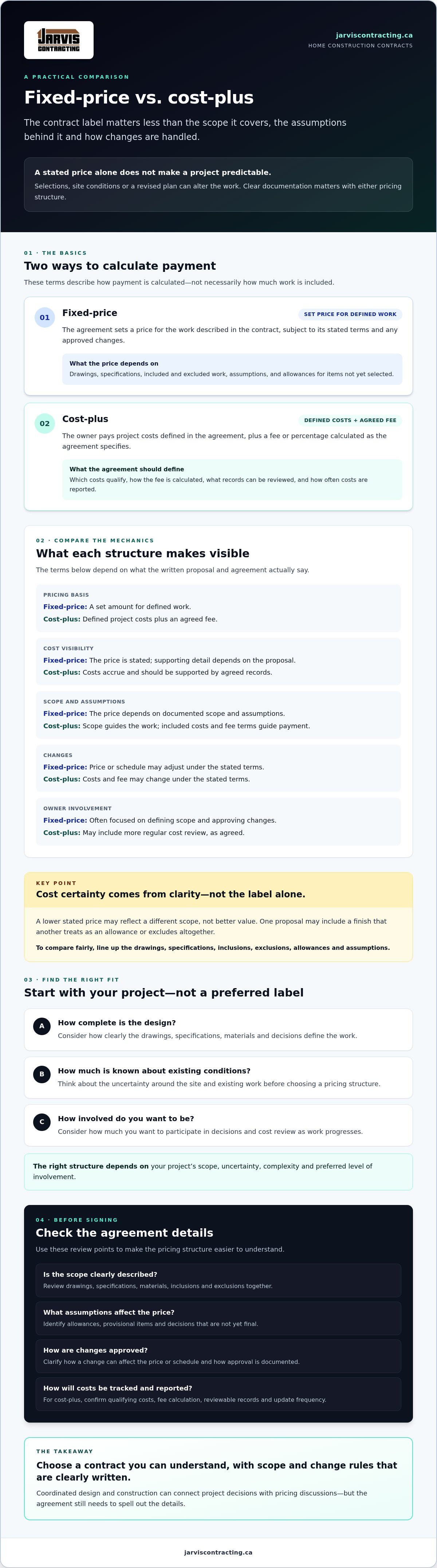
Fixed-price: A set price for a defined scope of work, subject to the contract’s stated terms and any approved changes.
Cost-plus: Payment for defined project costs, plus a fee or percentage calculated as the agreement specifies.
These plain-language definitions are a starting point, not a substitute for reading the documents. In a fixed-price vs cost-plus construction contract comparison, the main distinction is how the agreed price is calculated. Neither label alone guarantees a final amount or explains what happens when the scope changes or an assumption proves inaccurate.
What is a fixed-price construction contract?
A fixed-price agreement sets a price for the work described in the contract. That price is tied to its defined scope and terms, so it shouldn’t be read as an unconditional promise that no additional charges can arise. For example, a renovation price may depend on specified cabinetry and finishes. Changing those selections later could affect the agreed work and price.
Drawings and specifications show what the price is based on. Inclusions and exclusions clarify what is and isn’t part of the work, while allowances set budget placeholders for items not yet selected. Review these details together. Without understanding the scope behind a price, it’s difficult to assess what it covers or compare it with another proposal.
What is a cost-plus construction contract?
With cost-plus, the owner pays project costs defined in the agreement, plus an agreed fee or percentage. As the Cost-plus contract reference explains, the structure is based on reimbursing costs and adding a fee. The written agreement should state which costs qualify, how the fee is calculated and what records the owner can review.
Cost-plus doesn’t automatically mean costs are uncontrolled or hidden. The agreement can set documentation and reporting expectations so the owner can follow costs as they accrue. Clarify which costs are included, how the fee applies to them and how often you’ll receive an update. Without those details, the contract label alone offers little clarity about the final amount.
How fixed-price and cost-plus contracts handle costs, changes and uncertainty
The contract structure affects how costs are calculated and tracked, but clear documentation matters in either case. A fixed-price proposal states an amount for defined work, while a cost-plus agreement tracks costs as they accrue. For a general reference, the U.S. Federal Acquisition Regulation outlines Fixed-Price Contracts for federal procurement. It isn’t a rule for Canadian residential projects, so homeowners should focus on the terms in their own agreement.
Cost certainty depends on documented scope and change controls, not the contract label alone. To compare proposals fairly, line up the drawings, specifications, inclusions, exclusions, allowances and assumptions. One proposal may include a finish that another treats as an allowance or excludes altogether. A lower stated price may reflect a different scope, not better value.
What costs and records should the agreement define?
For cost-plus, check how the agreement treats labour, materials, subcontractors, equipment and other project expenses, along with the fee calculation. For either structure, review allowances, who can approve spending and whether approval is required before a cost is incurred. Ask which invoices, receipts or other records you can review, and how often cost reports will be provided. An agreed reporting schedule makes it easier to follow spending and raise questions while decisions are still open.
How do change orders and unknown conditions affect the comparison?
An owner-requested change, such as choosing a different finish, differs from an unforeseen condition discovered after work begins, such as concealed damage. Either may affect cost or schedule, depending on the contract and circumstances. Ask how each will be priced, documented and approved. Written change records should describe the revised work and any known price or schedule impact. Clarify whether work must wait for your approval and what process applies if an immediate decision is needed.
When discussing a custom home, addition or major renovation, ask how the proposed scope, assumptions and approval process will be documented. A residential design-build team can discuss how design decisions connect with construction planning and pricing questions.
Which construction contract suits a custom build, addition or major renovation?
Project type alone won’t determine the right pricing structure. Consider how settled the design and scope are, what remains uncertain and how involved you want to be in cost decisions. The Federal Acquisition Regulation definitions describe U.S. federal procurement categories, not rules for Canadian residential construction. They illustrate the broad distinction: one structure sets a price for defined work, while the other reimburses costs under agreed terms.
When weighing fixed-price vs cost-plus construction contract options, assess the project’s readiness before comparing labels. Are the drawings and specifications developed? Have you selected key finishes, or are allowances still needed? Could investigation uncover existing conditions that affect the work? Would you prefer a defined price for documented scope, or regular cost information as decisions are made? Neither approach is inherently cheaper, safer or better for every project.
When might fixed-price be a practical fit?
A fixed-price proposal may be easier to assess when the drawings, specifications and selections describe the work clearly. A custom home, for example, could be considered for this structure if its design, materials and scope are sufficiently defined. That doesn’t make every custom build a fit. Unresolved details can leave important assumptions to clarify.
Review exclusions, allowances and the process for changing scope. Ask what happens if you choose a different finish or request additional work, and how the resulting price and schedule will be documented. A stated price is most useful when you can see exactly what it includes.
When might cost-plus merit consideration?
Cost-plus may be worth discussing when the scope is still evolving or some conditions can’t be confirmed before work begins. In an addition or major renovation, opening up an area may reveal existing conditions that require further investigation and decisions. That possibility doesn’t automatically make cost-plus the right choice. It does make the agreement’s cost and approval processes especially important.
Before considering this structure, clarify which expenses count as project costs, how the fee is calculated, what records you can review and when you’ll discuss spending. Agree on approval points and how proposed changes will be presented. Make sure the reporting process is clear and that the level of involvement suits you.
Coordinated design and construction can bring scope decisions and pricing discussions together as a project develops. Ask any prospective partner how design readiness, assumptions and unresolved choices will be reflected in the proposal, whichever contract type you’re considering.
Questions to ask before signing a fixed-price or cost-plus contract
Before comparing headline totals, make sure each proposal describes the same work and explains how decisions will affect the agreement. Use this checklist to identify gaps while there’s still time to clarify them. The answers should appear in the proposal or contract documents, not remain informal assumptions.
What work is included? Ask which drawings, specifications, materials and project responsibilities the price covers.
What’s excluded? Identify work outside the stated scope and confirm who is responsible for it.
How are allowances or provisional items handled? Ask what they cover, how selections or actual costs are reconciled, and whether an amount can be exceeded.
How is the price calculated? For fixed-price, confirm the price applies to the documented scope and stated terms. For cost-plus, clarify eligible project costs, the fee calculation and any limits or approval points.
How are changes approved? Ask who can authorize a change, how its price and schedule impact will be recorded, and whether approval is required before work proceeds.
What cost records will I see? Confirm which invoices, receipts or reports are available and how often you’ll receive them.
What happens if an unknown condition is found? Ask how the issue will be described, priced and brought to you for a decision.
How can you compare proposals fairly?
Put each proposal beside the same current drawings and specifications. Compare inclusions, exclusions, assumed selections, allowances, work boundaries and stated responsibilities. If one proposal assumes a finish is selected while another carries it as an allowance, record that difference. Ask for clarification in writing before treating the totals as comparable. A coordinated design-build process can connect design decisions with construction planning. Read more about design-build benefits for Ontario homeowners.
What Ontario contract details deserve extra attention?
Contract requirements can depend on the project and the parties involved. Have an Ontario construction professional or lawyer review project-specific language, including any applicable statutory requirements, lien holdbacks and warranty coverage. Don’t assume a rule or warranty applies without confirming the details. Check that the agreement also addresses schedule, insurance, dispute processes and who is responsible for keeping and sharing project documentation.
Clear answers help you judge whether a fixed-price vs cost-plus construction contract aligns with your project and preferred level of cost visibility. For a custom home, addition or major renovation, clarify how design choices, construction planning and contract terms will be handled before deciding.
Choose a construction contract with clear scope and a team you can work with
The right contract should reflect how clearly your project is defined, how you want costs reported and how you prefer to make decisions as work progresses. A fixed-price vs cost-plus construction contract is only one part of that choice. The written scope, pricing assumptions and change process need to make sense for your project and feel workable for you.
In a design-build process, design decisions and construction planning can be considered together. Jarvis Contracting provides in-house architecture and design alongside residential construction, with single-point project management. This approach connects project planning, but it doesn’t promise a particular cost outcome. Early conversations about scope can bring design choices, pricing assumptions and potential changes into the same discussion.
For homeowners planning a custom home in the Durham Region, this guide to custom home builders in Durham Region offers more context on the design-build approach.
How does design-build support a more coordinated project?
When architecture, design and construction planning are connected, questions about materials, layout and project scope can be considered in relation to the work they affect. This can help identify unresolved decisions and clarify the assumptions behind a proposal. It doesn’t remove uncertainty, but it creates an opportunity to discuss how decisions may affect the project before they become changes to agreed work.
What should you bring to an initial project discussion?
You don’t need every decision finalized to start a useful conversation. Bring what you know and be clear about what’s still open. Helpful starting points include:
Your goals for the custom home, addition or major renovation, including what matters most in the finished space.
Available site or home details, preliminary plans, and any known constraints or existing conditions.
Selections you haven’t made yet, along with your budget priorities and comfort with reviewing costs during the project.
Questions about scope, assumptions, approvals, cost reporting and how changes will be discussed.
These details can help frame the conversation around project readiness and the decisions ahead. If you’re ready to discuss your goals and contract questions, contact Jarvis Contracting about your project. You don’t need every answer in hand. Start with what you know and ask what needs clarification before deciding how to proceed.
Move forward with a contract that fits your project
The fixed-price vs cost-plus construction contract decision comes down to more than the headline amount. Consider how clearly the work is defined, what remains uncertain and how you’ll see and approve costs as the project moves forward. A well-documented scope, clear assumptions and a workable process for changes matter whichever structure you consider.
Jarvis Contracting is a second-generation, family-owned Ontario firm founded in 2007, bringing in-house architecture and design together with residential construction and single-point project management. Coordinating these parts of a project can connect design decisions with construction planning, while clear contract documents remain essential.
Bring your goals, plans and questions about scope, pricing and approvals to a conversation with the team. Discuss your project and contract questions with Jarvis Contracting to explore what may suit your custom home, addition or major renovation. A thoughtful start can help you move ahead with greater clarity and confidence.
Frequently Asked Questions
What is the main difference between a fixed-price and a cost-plus construction contract?
The main difference is how the amount you pay is calculated. A fixed-price contract sets a price for defined work, subject to its terms and any changes. A cost-plus contract charges defined project costs plus an agreed fee or percentage. In a fixed-price vs cost-plus construction contract comparison, review the scope and payment terms too. The label alone doesn’t tell you what’s included or how costs will be documented.
Is a fixed-price construction contract always cheaper?
No. A fixed-price contract isn’t automatically cheaper than a cost-plus agreement. Proposals may cover different work, materials or finish selections, and allowances or exclusions can affect what the stated price represents. Compare the same drawings and specifications, then review each proposal’s assumptions, change process and included work. A lower headline amount may not represent the same finished scope, so clarify differences before deciding.
Can a cost-plus construction contract go over budget?
Yes. Under cost-plus, the amount paid can rise as eligible project costs accrue, with the agreed fee calculated as the contract specifies. Changes to the work, selections or conditions discovered during construction may affect total spending, depending on the agreement. Ask whether it sets spending limits or approval points, how often costs are reported and what records you can review. Don’t assume there’s a maximum unless the contract clearly provides one.
How do I compare fixed-price and cost-plus construction quotes?
Start by checking that each quote is based on the same drawings, specifications and work boundaries. Compare inclusions, exclusions, allowances, assumed selections and responsibilities. For cost-plus, clarify eligible costs, the fee calculation and available records. For either structure, ask how changes are priced and approved, and how schedule impacts are communicated. Put unresolved differences in writing before treating headline totals as comparable.
What happens if renovation work reveals unexpected conditions?
The next steps depend on the contract and the condition uncovered. Ask the contractor to document what was found, explain the proposed response and identify any cost or schedule implications. Clarify how the work will be priced and who must approve it before proceeding, where the agreement allows. For example, concealed damage may require further investigation and a decision about additional work. Keep the related discussion and approvals in writing.
Should I have an Ontario construction contract reviewed before signing?
Yes, consider asking an Ontario construction lawyer or qualified professional to review the project-specific contract before you sign. They can help you understand how the written terms apply to your circumstances. Ask them to check which statutory requirements, lien holdbacks and warranty provisions may apply, rather than assuming they do. Also make sure the documents clearly address schedule, insurance, dispute processes, approvals and who is responsible for project records.
Is cost-plus suitable for a custom home or major renovation?
It may be worth discussing if the scope is evolving or some project details remain uncertain, but the project type alone doesn’t determine suitability. Consider how complete the design is, how you want costs reported and how involved you’re prepared to be in decisions. Jarvis Contracting is an Ontario design-build firm serving Toronto, Whitby, Oshawa, Pickering, Ajax, Port Perry, Uxbridge, Markham, Richmond Hill, Aurora, Vaughan and King City. Ask about scope and contract terms before choosing.


Comments