
25 Essential Questions to Ask a Custom Home Builder Before You Sign

Updated: 4 days ago
A stunning portfolio is often the least important factor to consider when you're choosing the person who will hold the keys to your family's future for the next eighteen months. While aesthetics matter, they don't reveal how a firm handles a surprise site condition in Durham or a complex permit delay in a York Region municipality. You're not just buying a house; you're entering a multi-year partnership that requires absolute transparency and shared values. Knowing the right questions to ask a custom home builder is the only way to protect your investment and your peace of mind before any ground is broken.
We understand the weight of this decision because we've spent decades as a second-generation firm seeing exactly where these complex projects can go wrong. It's natural to feel anxious about hidden costs or the confusing divide between architects and contractors. This article equips you with a professional vetting framework to keep your Ontario build on schedule and on budget. We'll walk through 25 critical inquiries that cover everything from in-house architecture to cost-plus contracts, giving you the confidence to choose a partner who values craftsmanship and integrity as much as you do.
Table of Contents
Vetting Experience: Questions About History and Credentials
Building a custom home is a marathon, not a sprint. The first set of questions to ask a custom home builder should focus on their staying power and professional history. Ask how many years they've operated under their current business name. This simple inquiry reveals much about their stability and ethical track record. It's common for less reliable contractors to close one business and open another to escape past debts or poor reputations. A firm with decades of history shows they've successfully weathered market shifts and stood behind their work.
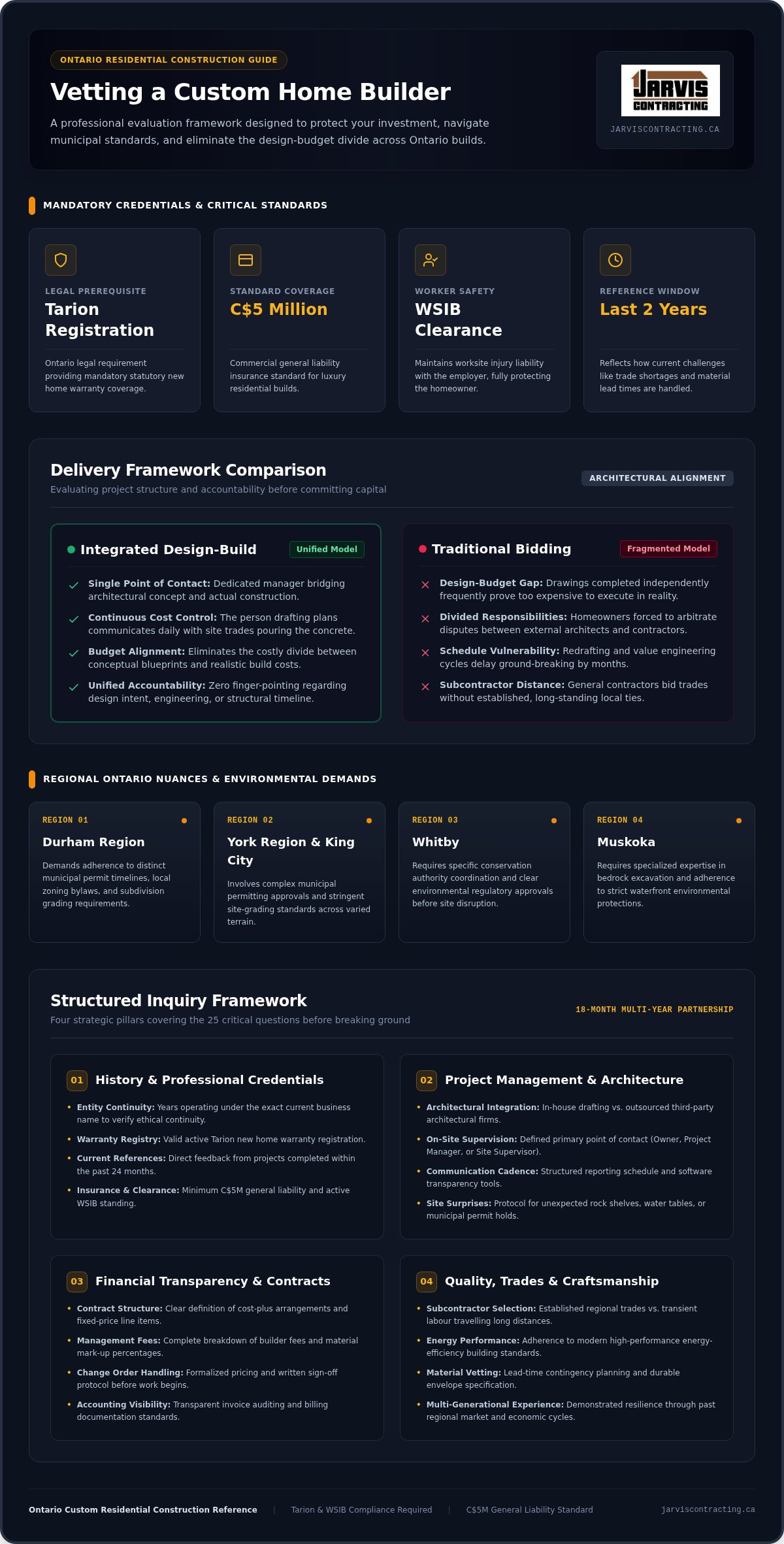
Don't stop at a website gallery. Ask for a list of references from projects completed within the last two years. While older testimonials have value, recent clients can explain how the builder manages current market realities, such as labour shortages or material lead times. These initial questions to ask a custom home builder help you separate established professionals from those who might be learning the ropes on your dime.
Understanding Local Ontario Credentials
In Ontario, every legitimate builder must be registered with Tarion. This isn't a suggestion; it's a legal requirement that provides you with a mandatory new home warranty. If a builder isn't registered, your investment lacks the protection it deserves. Beyond Tarion, verify their standing with the Workplace Safety and Insurance Board (WSIB). This ensures that if an accident occurs on your site, the liability stays with the employer, not you. Finally, confirm they carry at least C$5 million in commercial general liability insurance. This level of coverage is the professional standard for high-end residential projects, protecting both the structure and the surrounding environment during construction.
The Value of Regional Expertise
A builder who excels in the core of Toronto might struggle with the specific conservation authorities in Whitby or the grading requirements in King City. Every municipality has its own rhythm. Building in the Durham Region, for example, involves different permit timelines and zoning bylaws than those found in York Region. You need a partner who understands these local nuances to avoid costly delays.
If you're planning a project in Muskoka, the challenges change entirely. You'll need an expert who is comfortable with rock excavation and the strict environmental protections that govern waterfront properties. A builder with deep regional roots also brings a vetted network of local subcontractors. These relationships are essential. They ensure that specialized trades are available when needed, preventing your project from sitting idle while a crew travels from hours away. Local knowledge isn't just about paperwork; it's about the efficiency of the entire build process.
The Design-Build Process: Questions About Project Management
The transition from a blueprint to a foundation is where most projects face their hardest tests. When you're interviewing, the project management questions to ask a custom home builder will determine whether your experience is a collaborative journey or a series of stressful negotiations. One of the first things to clarify is whether they handle architectural design in-house or if you'll need to manage an external firm. An integrated approach ensures that the person drawing the lines is talking to the person pouring the concrete every day, which keeps the project's integrity intact from start to finish.
Single Point of Contact vs. Traditional Bidding
A traditional bidding process often creates a "design-budget gap" where a beautiful set of plans is simply too expensive to build. By exploring the benefits of design build construction, you'll see how a unified team prevents finger-pointing between architects and contractors. Ask specifically who your primary point of contact will be once construction begins. Is it the company owner, a dedicated project manager, or a site supervisor? Having one person accountable for both the design integrity and the construction schedule simplifies your life. This level of unity is what separates a legacy builder from a volume contractor.
Communication Schedules and Software
Transparency shouldn't be an afterthought. Ask how the firm manages updates and site-specific surprises. Whether it's a hidden rock shelf in Muskoka or a grading issue in a Durham subdivision, you need to know the process for handling change orders before they happen. While general U.S. Department of Housing and Urban Development home buying guidance offers a broad look at consumer protections and builder relations, a local Ontario builder should provide specific details on their communication rhythm. Establishing these questions to ask a custom home builder about their communication rhythm will prevent the "hidden cost" anxiety that often plagues homeowners.
Will there be scheduled weekly site meetings or digital progress reports?
How are "change orders" documented and approved to avoid financial surprises?
What happens if a specific material, like custom windows, is delayed by the manufacturer?
A professional firm will have a methodical system for documenting changes and approvals. This prevents the confusion that can lead to budget overruns. If you're looking for a partner who treats your project with the precision of a craftsman and the heart of a family business, choosing an integrated design-build team can provide the clarity you need to move forward with confidence.
Financial Transparency: Questions About Budget and Contracts
A custom home represents a significant financial commitment. While the design and layout capture your imagination, the contract you sign dictates how that dream is funded and protected. One of the most vital financial questions to ask a custom home builder is whether they prefer a Fixed Price or a Cost-Plus contract. This choice impacts your risk level and your involvement in every line-item expense. You should also ask how they calculate their management fees. Some firms charge a flat fee, while others take a percentage of the total build cost. Understanding this early prevents friction when the first invoices arrive.
Clarity on "standard" finishes versus "upgrades" is equally important. Builders often use different definitions for quality. What one contractor calls a luxury finish might be the baseline for another. Ask for a detailed list of what is included in the base price. This should cover everything from the type of insulation to the specific brand of windows. If you're building during a period of market volatility, ask how they handle budget overruns caused by sudden spikes in material costs like lumber or concrete. A professional builder will have a clear policy for these scenarios, ensuring you aren't left with an unfinished project due to external market shifts.
Comparing Ontario Contract Types
A Fixed Price contract offers the security of a hard number, which is helpful for financing and peace of mind. However, builders often include a contingency buffer to cover unexpected costs. Conversely, a Cost-Plus model provides total transparency on every invoice, but it requires a high level of trust in your builder's efficiency. Many major home renovation contractors Ontario residents trust prefer the Cost-Plus model for complex, high-end builds because it ensures the client only pays for exactly what is installed, without hidden markups.
Defining the Scope of Work
Before signing any agreement, ask for a detailed "Schedule of Values." This document breaks down the total cost into specific categories like excavation, framing, and electrical. It's the only way to truly compare quotes between different firms. You should also inquire about how allowances are determined. If a builder gives you a C$20,000 allowance for a kitchen but your vision requires C$50,000, your budget will break before the drywall is even up. Ensure the payment schedule is linked to specific construction milestones, such as the completion of the foundation or the roof being shingled. This ensures you only pay for work that has been verified and completed to your standards.
Quality and Craftsmanship: Questions About the Build
The true measure of a builder isn't found in a glossy brochure. It lives in the hidden details of a wall assembly or the precision of a mitre joint. When you're interviewing, the technical questions to ask a custom home builder will reveal if they are a true craftsman or simply a project coordinator. One of the most telling requests you can make is to visit a home currently under construction. A finished home hides its secrets behind drywall, but an active site shows you the builder's standards for safety, site cleanliness, and the quality of the building envelope before it's covered up. This focus on transparency during the construction phase is something that boutique luxury firms like Maverick Design and Construction prioritize to ensure every project meets the highest standards of craftsmanship.
Beyond basic building codes, ask about energy-efficiency standards like Energy Star or Net Zero. These aren't just buzzwords; they represent a commitment to longevity and comfort. A builder who understands these systems will be able to explain how they handle thermal bridging and air sealing. This level of detail ensures your home remains comfortable during a -30°C February night without sending your utility bills soaring. It's about building for the next fifty years, not just the next five. Quality control should be a methodical process, not a final walkthrough. Ask how they document inspections at critical stages, such as before the insulation is installed or after the windows are flashed, to ensure the structure is moisture-tight.
Building for the Canadian Climate
Ontario's climate is notoriously demanding on residential structures. You need a builder who understands the nuances of insulation and vapour barriers specifically for our freeze-thaw cycles. Ask how they ensure a "tight" building envelope to manage air quality and energy costs. A Muskoka modern farmhouse requires different moisture management strategies than a suburban custom home in the GTA. Whether it's managing high wind loads on a lakefront or ensuring superior thermal performance in a York Region subdivision, your builder must have a strategy for the local environment.
The Subcontractor Relationship
The quality of your home is only as good as the tradespeople who build it. Ask how the firm selects and vets its subcontractors. Do they have long-standing relationships with their plumbers and electricians, or do they bid every job out to the lowest price? A builder who has worked with the same crew for a decade offers a level of consistency that a low-bid contractor cannot match. You should also clarify who is responsible for daily site maintenance. A clean, organized site is often a reflection of a builder's respect for the craft and the surrounding neighbourhood.
If you're looking for a team that treats your build with the same care as a family legacy, connect with our in-house design and construction experts to discuss your vision.
Finalizing Your Choice: The Design-Build Advantage
Selecting the right partner for your project is about more than just checking boxes on a list. It's about finding a team that shares your vision for quality and your commitment to integrity. In our experience, the design-build model has become the preferred choice for custom home builders Durham Region families rely on. This approach eliminates the "design-budget gap" where an architect creates a beautiful plan that a contractor simply cannot build for the stated price. By integrating these roles under one roof, we ensure that every line drawn on a blueprint is informed by real-world construction costs and technical feasibility.
The most effective questions to ask a custom home builder are those that reveal how they handle accountability. In a traditional model, the homeowner often finds themselves caught in the middle of disputes between the designer and the builder. An integrated team removes this friction. When the person responsible for the drawings is the same person responsible for the foundation, there is no room for finger-pointing. This unity provides a level of peace of mind that is essential for a multi-year investment. It's about creating a seamless journey from your initial concept to the day you receive your keys.
The Jarvis Contracting Difference
We are a second-generation, family-owned firm founded in 2007. This heritage is the foundation of our business. It means we approach every project with a craftsman's heart and a professional's precision. Our in-house architecture and design team works directly with our construction leads from day one. This integration is our greatest strength. It allows us to maintain a single point of contact for our clients, ensuring that your vision is never lost in translation. We take immense pride in our Ontario craftsmanship, focusing on homes that reflect the unique lifestyle of each family, whether we are building a modern farmhouse in Muskoka or a bespoke residence in the GTA.
Ready to Start Your Journey?
Your first meeting with a builder should be about "fit" as much as it is about "facts." You're choosing a partner for a significant chapter of your life. You need to feel certain that they listen to your concerns, respect your environment, and value your budget. To prepare for your first consultation, gather your ideas and any site-specific information you have. We'll help you navigate the local permitting landscape in Durham or York Region and explain the technical requirements of your build. If you're ready to move from planning to execution with a team that values tradition and modern standards, book your custom home consultation with Jarvis Contracting today.
Building Your Legacy with Confidence
Choosing the right partner for your custom home is one of the most significant decisions your family will ever make. By arming yourself with these essential questions to ask a custom home builder, you've taken the first step toward a transparent, well-managed project. You now understand how to vet credentials, why the design-build model protects your budget, and how to identify true craftsmanship in our unique Canadian climate. A successful build isn't just about the final structure; it's about the trust and clarity maintained from the first sketch to the final walkthrough.
Since 2007, our family-owned firm has provided full-service design-build expertise across the GTA, Durham, and Muskoka. We take pride in being a second-generation business that treats every project as a reflection of our own standards. If you're ready to move forward with a team that values integrity and professional precision, we're here to guide you. Download our Custom Home Planning Guide or Book a Consultation today to discuss how we can bring your vision to life. Your dream home deserves a foundation built on expertise and shared values.
Frequently Asked Questions
How do I know if a custom home builder is reputable in Ontario?
A reputable builder must be registered with Tarion and maintain an active account with the Workplace Safety and Insurance Board (WSIB). You should look for a proven history in specific regions like Whitby or King City. Our second-generation firm has operated since 2007, showing the stability required for these complex projects. Always ask for recent references to verify their current standing with trades and local municipal planning departments.
What is the most important question to ask a builder during the first meeting?
The most critical inquiry involves their project management structure. Ask if they use a design-build model with a single point of contact. This integrated approach is one of the most vital questions to ask a custom home builder because it prevents the design-budget gap. Knowing who is accountable for both the architectural drawings and the site execution ensures your vision stays on track without the stress of managing multiple parties.
Do custom home builders handle the permits and zoning in the GTA?
Full-service design-build firms typically manage the entire permitting and zoning process. Navigating the specific bylaws in municipalities like Markham, Richmond Hill, or Vaughan requires deep local expertise. We handle the coordination with conservation authorities and municipal planners to ensure your project meets all Ontario Building Code requirements. This integrated service prevents the delays that often occur when homeowners try to manage complex permit applications on their own.
What is the difference between a custom builder and a production builder?
A custom builder creates a unique, one-of-a-kind home tailored specifically to your lifestyle and site. Production builders usually work from a limited library of floor plans in large subdivisions. With a custom build, you have control over every detail, from the building envelope to the final finishes. This bespoke approach allows for specialized projects like Muskoka modern farmhouses that a volume-based production builder isn't equipped to execute.
How long does the typical custom home build take in the Durham Region?
A typical custom home in the Durham Region generally takes between twelve and eighteen months to complete once ground is broken. This timeline depends on the complexity of the design and the specific permit requirements in towns like Pickering or Ajax. Site-specific challenges, such as environmental protections or complex grading, can also impact the schedule. An integrated design-build team helps streamline this timeline by coordinating architectural phases and construction starts more efficiently.
Can I change the design once construction has started?
Changes are possible through a formal change order process, though they often impact both the budget and the schedule. Once the building envelope is established or structural elements are in place, modifications become significantly more expensive. We recommend finalizing as many details as possible during the in-house design phase. If a change is necessary, we document the costs and timeline adjustments clearly to ensure there are no surprises during the final walkthrough.
What happens if my custom home build goes over budget?
Budget overruns are usually managed through the contingency fund established at the start of the project. The type of contract you sign, such as Cost-Plus or Fixed Price, determines how market fluctuations are handled. Using an integrated design-build model is one of the best ways to prevent these issues. Our team aligns the architectural vision with real-world construction costs from the beginning, reducing the risk of unexpected financial gaps when considering questions to ask a custom home builder.
Is a Tarion warranty mandatory for all custom homes in Ontario?
Yes, the Tarion warranty is a legal requirement for all new homes built for sale or under contract in Ontario. It provides essential consumer protection covering everything from work and materials to major structural defects. Every legitimate builder must be registered and provide you with the necessary enrolment documents. This mandatory coverage ensures that your investment in a new custom home is protected according to provincial regulations for up to seven years.


Comments